
Luna County 72-Hour Feed Status
Luna County’s official detention navigation leads to a current JailTracker roster. Neither that navigation nor the public portal exposed a labeled 72-hour release list during the source review. No public update cadence or post-release visibility period was published. The roster is still useful, but only as a snapshot of who the public system presently associates with Luna County Detention Center.
A three-day release list should contain actual exit events for a defined interval. The live roster does not claim to do that. Its changing population cannot show whether a person left on bond, completed a sentence, was released by court order, had an Adult Probation Office hold lifted, transferred to another jail, entered NMCD custody, or moved under federal authority.
Build a Luna County Three-Day Window
The strongest method is a date-bounded request. Choose a start timestamp, an end timestamp, and a time zone. Ask Luna County whether an existing Jail Management System report or release log covers that interval. If no such list exists, request the named booking files for the people being checked. New Mexico IPRA requires reasonably particular identification of records, but it does not force an office to compile a new report.
- Write down the exact three-day interval, including its opening and closing times.
- Check the official current roster for each known name, treating nonappearance only as “not found now.”
- Call LCDC at 575-544-0191 for a prompt status check and ask whether each exit was community release or transfer.
- Submit Luna County’s official data request for the existing log or precise release files.
- Compare each result with the court, NMCD, VINE, or federal record that fits the custody path.
Keep the county response and any produced record together. A saved roster screen may help show what was visible at one moment, but it cannot supply the missing release authority or receiving agency.
If the request seeks all releases, ask first whether that report already exists for the stated interval. If it does not, narrow the task to known people and bookings. The facility is not required to create a new spreadsheet or calculate a list that its system does not maintain. A precise request also reduces the chance that protected juvenile, medical, victim, or security information will delay review of otherwise public fields.
Luna County 72-Hour Record Fields
A useful release record identifies the person, the custody episode, the actual end of that placement, the legal basis, and the destination. LCDC policy describes a linked record chain rather than one universal certificate. It includes JMS entries, the detainee folder, written authority, identity checks, a detainer review, and staff signoff.
| Requested field | Why it matters across 72 hours |
|---|---|
| Full name, aliases, DOB | Separates similar names and supports a sound identity match. |
| Booking or detainee number | Connects the answer to one custody episode. |
| Actual release date and time | Places the event inside or outside the exact three-day interval. |
| Release reason and authority | Distinguishes bond, time served, court action, APO-hold release, dismissal, and other outcomes. |
| Receiving agency | Shows a transfer or extradition rather than community release. |
| Detainer disposition | Explains whether another lawful hold affected the exit. |
The county policy also says released detainee files are archived electronically. It does not state a public destruction date or promise a fixed retention term. Ask whether an older booking remains in the current JMS, an archive, or the applicable retention schedule.
Luna County Weekend Release Checks
A 72-hour interval is especially practical when the period crosses a weekend or holiday. It reduces the chance that a person who left near a day boundary is omitted from a request framed only by calendar labels such as “today” or “yesterday.” Still, the length of the window does not solve a source problem. Luna County publishes no service promise saying that JailTracker shows a release within a set number of hours.
Use exact timestamps rather than asking staff for “the weekend list.” A Friday evening through Monday evening request, for example, should state the dates, times, and local time zone. If the goal is one person rather than all events, a named file is usually clearer. Include the booking date or number when known.
Court entries may post on a different schedule from jail processing. A bond order or dismissal can establish legal authority, yet the jail file best records the physical exit after identity, warrant, detainer, and paperwork checks. Do not assume both events share one timestamp.
Note: Use the 24-Hour Release List method when the question is limited to a same-day interval.
Why Luna County Has No Feed
The official Luna detention page now links the live roster, and local reporting says JailTracker was adopted in 2025. That adoption report concerned the booking system and communications. It did not promise a public 72-hour archive, identify a rolling release filter, state how often the public portal refreshes, or define how long an exited person remains visible.
The official source screenshot below shows why the distinction matters. It documents a present-roster tool, not a three-day list.
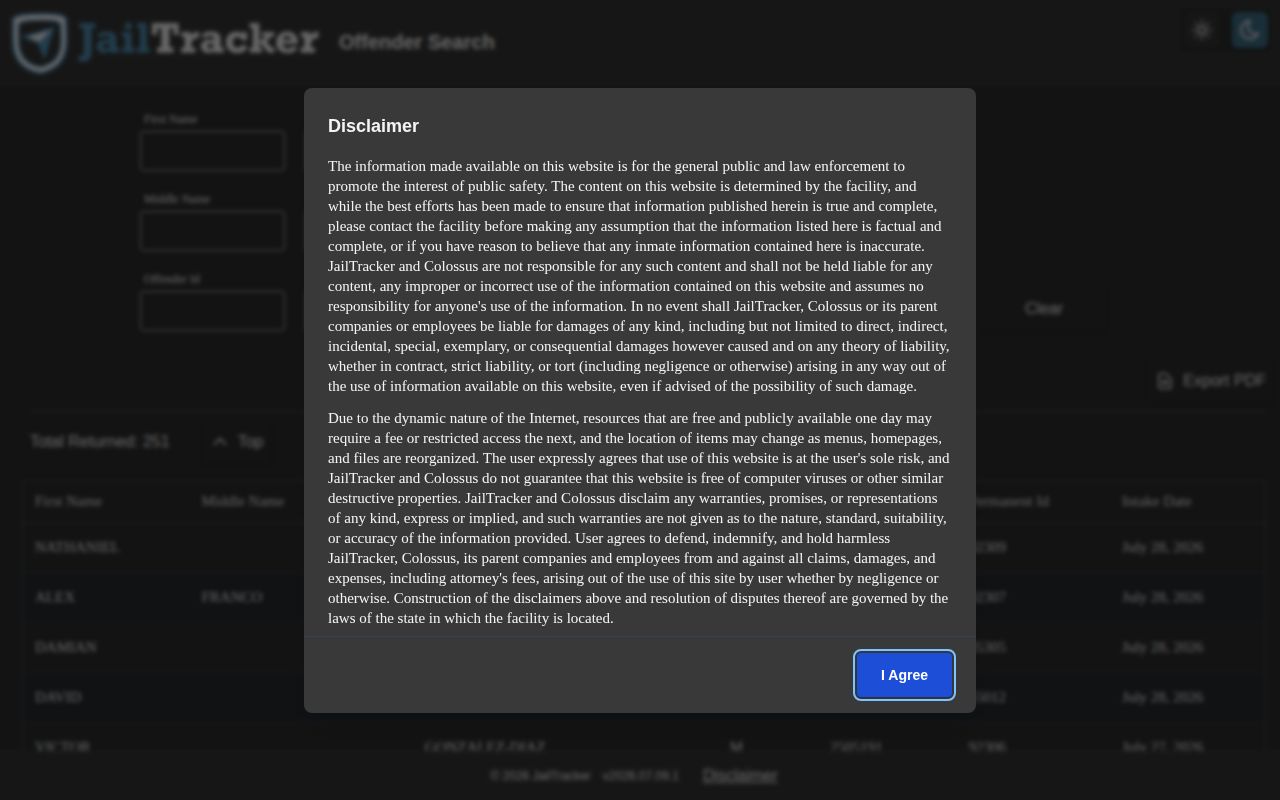
The image should be read as a route to current custody information. Release history must come from the jail’s archived record or another agency’s matching record.
Commercial arrest pages do not fill this gap. A recent arrest or booking photo says that a booking occurred. It cannot prove when or why that placement ended, and it cannot distinguish release from transfer.
A roster check taken on each of three days remains three snapshots. It does not become a transaction history. A person could appear, disappear, and later return under a new booking. Another person could stay absent throughout the period because the public record was delayed or restricted. The booking number and actual release entry are what connect the answer to the correct custody episode.
Verify Luna County Release Outcomes
Match the next search to the releasing authority. NMCD Offender Search covers state prisoners and people under NMCD probation or parole. It expressly does not cover county or city detention custody. New Mexico Case Lookup can identify public court action, while VINE can supply supported custody events or alerts. Federal pretrial movement may require the federal docket and U.S. Marshals channel because the BOP locator does not show every contract placement.
| Roster exit | Meaning | Verification route |
|---|---|---|
| Community release | The person left the jail placement under lawful authority. | LCDC release entry plus court or bond document. |
| Transfer or extradition | Custody continued with another jurisdiction. | Receiving-agency field and transfer paperwork. |
| State commitment | Custody moved from county jail to NMCD. | NMCD search and judgment, allowing for update lag. |
| Federal movement | A USMS contract detainee moved or left under federal authority. | Federal docket, USMS inquiry, and Luna release file. |
| Data gap | No reliable custody outcome is established. | Call LCDC and request the named record. |
A VINE “released” alert also needs context. It records a custody-status event, not an acquittal or the legal reason for release. If the person transfers to another jail or into NMCD, a new registration may be needed in that custody system.
NMCD search results require their own careful reading. A former state prisoner may remain visible while on probation or parole, and an inactive search option may be needed for an older state record. That does not mean every Luna jail release will appear there. Use NMCD only when the person’s path actually reached state prison or state supervision. The county archive remains the source for the end of the LCDC placement.
Similarly, a federal contract detainee housed at LCDC may not yet appear in the BOP locator. U.S. Marshals pretrial custody can use local contract space before a federal sentence. Check the federal case and the receiving authority, then read the Luna transfer record. The three-day window measures the end of Luna’s placement, not necessarily the end of federal custody.
Get Luna County Three-Day Proof
Request the releasable booking ID sheet, release or discharge screen, written release authority, actual release date and time, reason or type, receiving agency if transferred, and detainer disposition. Ask for existing electronic records. Exclude juvenile, medical, victim-identifying, sealed, expunged, and security-sensitive material from a broad request.
Luna County Detention Center1700 E. Fourth St.
Deming, NM 88030
575-544-0191
When court proof is needed, use New Mexico Case Lookup to identify the filing court and case number. Then request the actual document from Luna District Court or Magistrate Court within the Sixth Judicial District. A docket summary may point to a bond, dismissal, judgment, or release order, but it does not replace the jail’s physical-exit entry.
Juvenile custody requires a separate lawful route through the juvenile court, counsel, or CYFD-authorized process. Public New Mexico Case Lookup excludes juvenile criminal cases, and the adult Luna roster should never be used to infer a child’s detention or release.