
Luna County Projected Release Meaning
A projected release date is an administrative estimate built from the controlling sentence and the information known to the custodian. It can move. An actual release date records an event that already occurred. Sentence discharge is later in some cases because parole or another legal obligation may continue after prison custody ends. These labels should never be collapsed into one date.
Luna County Detention Center handles local pretrial detainees and some sentenced people. A pretrial person usually lacks a fixed release date because a judge, bond, dismissal, detainer, or transfer can change the path. The jail policy says staff enter a duration of confinement if known, compare the release date in the detainee folder and jail management system, and release at sentence completion unless a lawful detainer intervenes.
NMCD uses Projected Release Date as an internal label on its earned-deduction form. Another form is titled Change of Projected Release Date. Those names show that the calculation is maintained and may be revised. Public search results must still be read by their exact live labels.
Find Luna County Projected Dates
Start with custody type. The official Luna County current roster can show whether a person is presently visible at the jail, but it is not a projected-date calculator or release archive. NMCD covers people committed to state corrections and people on its probation or parole. It expressly has no jurisdiction over county or city detention facilities.
- Identify the current custodian. Check the Luna roster for county custody and the NMCD direct offender search for state prison or supervision.
- For a county sentence, obtain the judgment and sentence from the correct Luna County court. Ask LCDC for its existing date calculation and any detainer information.
- For an NMCD sentence, search by name or NMCD number. Review the exact date and status labels, then contact the institution or Inmate Records.
- Compare the agency date with the judgment, presentence confinement credit, amended orders, and consecutive or concurrent sentence terms.
- Near the expected event, confirm with the custodian. After release, obtain the actual release or discharge record.
The Luna County release-record workflow explains how to request the archived jail file when a person vanishes from the current roster. A roster exit can also mean transfer, extradition, NMCD commitment, or another custodian, not community release.
Note: Never borrow NMCD prison deductions to estimate a Luna County jail sentence; the judgment and custodian’s own calculation control.
Luna County NMCD Date Search
NMCD Offender Search accepts first name, last name, and NMCD number. The direct tool provides Active, Include Inactive, and Absconder Only options. Use multiple identifiers to confirm a match. Include Inactive matters when the person may have left prison or completed supervision. Adult Prison Division data update nightly, and NMCD says to allow time for a record to appear. The agency also warns that disappearance from the search does not prove release.
The official NMCD direct search capture illustrates the state route and its status controls:
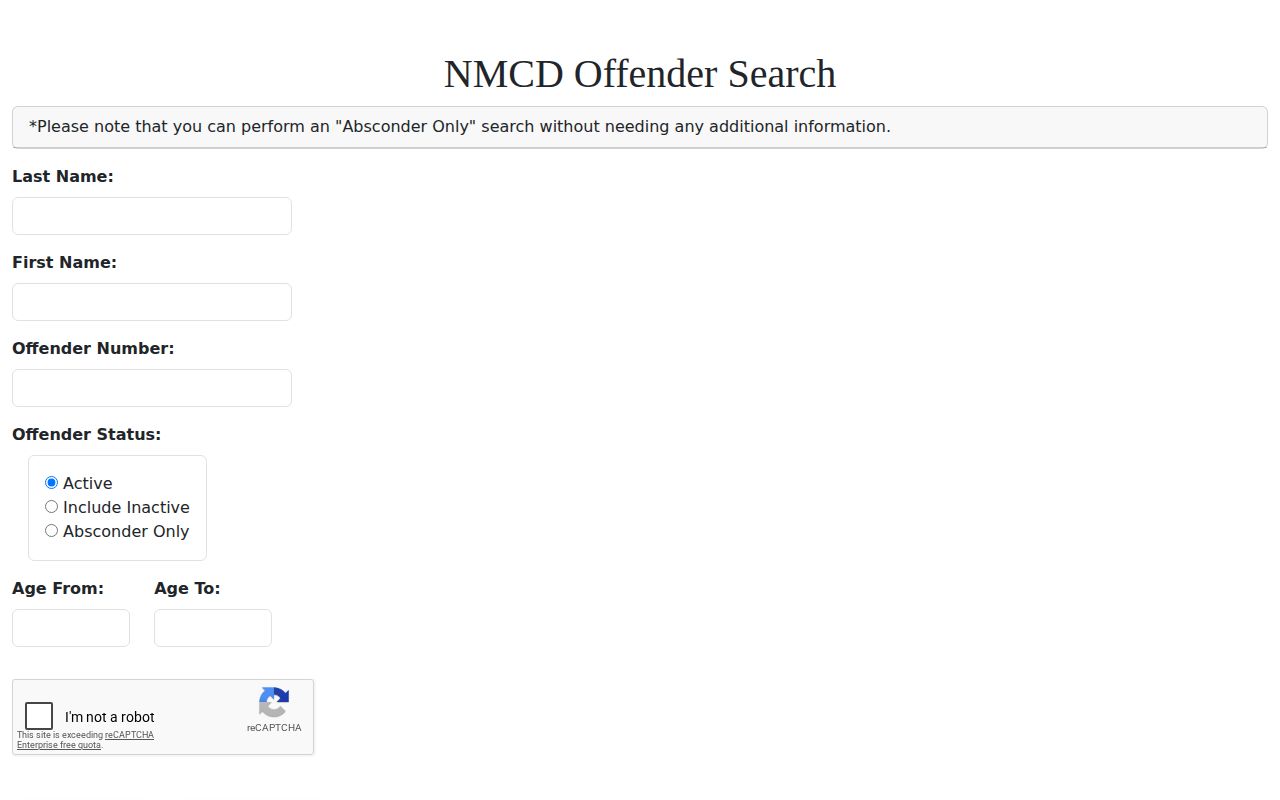
The search is best used to locate the correct record and office. It is not a substitute for the individual calculation held by NMCD Offender Management Services.
NMCD’s Office of Offender Management Services checks the judgment and sentence, determines the proper release date, applies earned or forfeited credit, and tracks the person from intake through release. Inmate Records is listed at 505-690-9790. Central Office and Constituent Services do not provide real-time release updates, so current status should be checked with the named institution or supervising office.
Luna County Earned Release Credits
NMSA 1978 § 33-2-34, available through NM OneSource, governs earned meritorious deductions for NMCD sentences. Eligibility and maximum deductions differ by offense category and applicable date. Serious violent offenses and certain sex offenses receive much smaller potential deductions than other eligible offenses. There is no safe universal formula.
Under current policy, the starting point is the remainder after presentence confinement credit. A qualifying serious-violent-offense sentence may receive no more than four days per month, while a qualifying nonviolent sentence may receive up to 30 days per month. The policy provides no earned deduction for the first 60 days in NMCD custody on a serious violent offense. Continued awards can depend on approved program participation, attendance, rule compliance, and assigned labor.
New Mexico also authorizes defined lump-sum deductions. Current categories include 30 days for an approved vocational, substance-use, or mental-health program; 90 days for a high-school-equivalency credential; 120 days for an associate degree; and 150 days for a bachelor’s or graduate qualification. Statutory caps and exclusions apply. Life and life-without-parole sentences do not receive earned meritorious deductions against the life term.
Luna County July 2025 Transition
The July 1, 2025 transition is a key New Mexico calculation quirk. NMCD policy CD-080400 says qualifying people whose offenses occurred from July 1, 1999 through July 1, 2025 began receiving awards under the revised method on July 1, 2025. Awards, non-awards, forfeitures, and restorations from before the transition remain vested. They are not recalculated.
That split can give two Luna County cases with similar sentence lengths different credit histories. One may carry vested earlier awards, while another accumulates credits only under the revised method. A sentence summary alone will not reveal each monthly decision, program award, forfeiture, or restoration. Obtain the calculation record instead of performing arithmetic from the public case entry.
The policy gives a correction route through classification for an earned-meritorious-deduction error, but only during the current term of imprisonment. The person’s institution or assigned classification staff is therefore the proper route for a claimed error. A family member can gather the judgment and visible date labels, but NMCD must correct its own computation.
Note: Similar sentences can produce different dates because the transition preserved older credit decisions and applied the revised method going forward.
Luna County Release Date Changes
A projected date changes when the legal or administrative inputs change. Some events move it earlier, while others delay release or change the receiving custodian. Read the agency record beside the court judgment. A date without its label and source can mislead.
| Input | Possible effect | Best verification |
|---|---|---|
| Corrected jail credit | Changes the sentence remainder | Amended calculation and court record |
| Amended judgment | Changes length or terms | Filed judgment and NMCD update |
| Consecutive or concurrent terms | Changes how multiple terms combine | Judgment plus OMS calculation |
| Earned deductions | May move the projection earlier within law | NMCD credit history |
| Forfeiture or restoration | Moves the date later or restores credit | Disciplinary and classification record |
| Detainer or hold | Can block community release or cause transfer | Custodian and receiving-agency record |
| Parole action | Changes eligibility or planned release path | Adult Parole Board decision and certificate |
LCDC policy requires a detainer check before local release. An otherwise completed county sentence can therefore end in transfer rather than a walk into the community. NMCD also adjusts calculations when new sentence or detainer information arrives. Ask “released to whom?” as well as “released when?”
Luna County Parole Eligibility Dates
Parole eligibility is the date the Adult Parole Board may consider release. It is not a projected release date and does not guarantee release. A favorable decision can depend on an approved plan, a certificate, and written conditions. Denial, deferral, rescission, or later violation changes the path. Final discharge occurs only when the legal custody and supervision obligation ends.
- Projected release
- An agency estimate subject to lawful recalculation.
- Parole eligibility
- The point when discretionary Board consideration may occur.
- Actual release
- The completed departure or transfer shown in a release record.
- Discharge
- The formal end of the sentence or supervision obligation.
New Mexico parole eligibility depends on the judgment and current law, including NMSA 1978 § 31-21-10 and offense-specific rules. Life sentences and covered youth cases have distinct provisions. One generalized formula cannot replace the judgment or Board record.
Luna County Sentence Date Records
The court file supplies the legal inputs for a county or state calculation. New Mexico Case Lookup can identify status, charges, events, disposition, and sentencing entries. It does not provide the filed documents themselves. Search a name in last-first-middle order, narrow with date of birth and the Luna court, or use the full case number. A closed or disposed label does not establish the physical release date.
Felony matters are filed in the Sixth Judicial District Court at the Luna County Judicial Complex, 855 S. Platinum Ave. in Deming. Magistrate Court handles misdemeanors, DWI and traffic cases, and the early stages of felony cases from 912 S. Silver St. Ask the filing clerk for the judgment and sentence, amended judgment, release order, or other document that changed the confinement term. The New Mexico Courts IPRA portal can route a records request to the exact court. The Administrative Office of the Courts is not the custodian of each trial-court case file.
Compare the filed sentence with the custodian’s calculation, but do not assume a docket entry posted at the same moment as agency action. District and Magistrate information is updated daily and generally current within a day of court entry. The local docket view covers only a short forward window and may omit settings. It helps locate a hearing, not prove a completed release. For an NMCD sentence, supply the filed order to the institution or Offender Management Services when the public projection appears inconsistent.
Note: The court defines the lawful sentence, while LCDC or NMCD applies that sentence to the person’s custody and credit history.
Confirm Luna County Actual Release
Near the projected date, call the current custodian. For LCDC, use 575-544-0191 and ask whether lawful release authority and any detainer have been resolved. For NMCD, contact the named institution or Inmate Records. If VINE supports the particular record, an alert can flag a custody event, but the Luna County VINELink check must still be paired with agency proof.
After the event, request the actual release record. For a county jail booking, seek the release screen, signed authority, actual date and time, release reason, receiving agency if transferred, and detainer disposition. For an NMCD case, request the release or discharge record and the calculation behind the final date. The actual record resolves what the earlier projection could not.